
—————————————–
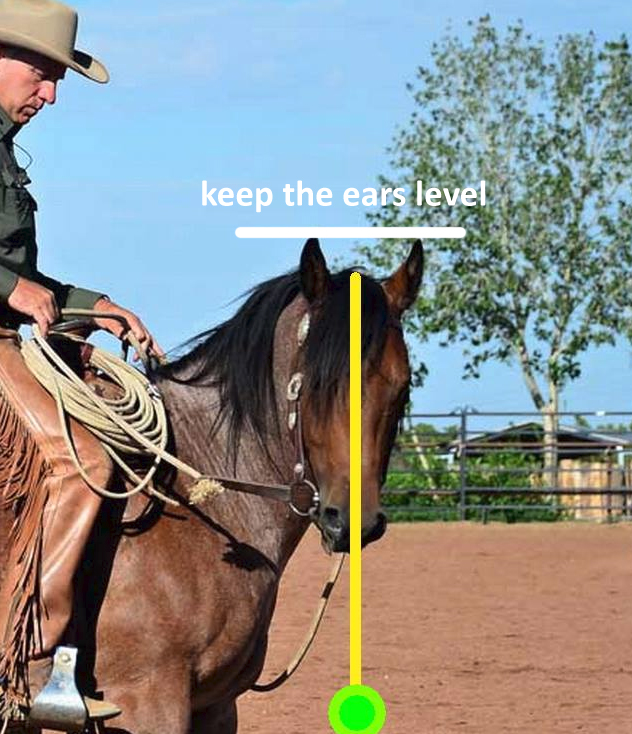
Buck Brannaman talking about lateral flexion;
“Imagine a pebble tied on a string to your horse’s forelock. When he turns his head to the side the stone should be hanging plumb with the string and be even between his nostrils. He should not come so far to the side that his nose tips up and one ear is pointing at the ground.”
Image of Buck and Reuben is by ‘the7msnranch’
—————————————-
Let me expand on that a little further. Some people may have experienced my demo of this with their horse in a lesson sometime. Stand your horse square, laterally bend him to 90 degrees where the ears stay level, then gently ask him to move his feet. He should find this pretty simple. Now bend him past 90 degrees so his ears tilt off to the side then ask him gently to move his feet. He will most likely pause (brace) adjust his balance or pull on the reins. This is all due to trying to keep his balance where his body says he should be standing still. Yes your horse can scratch his hip to get at a fly but do you ever see him doing this in motion? Nope.
The neck (cervical spine) of the horse has a lot of ability to bend and flex laterally and vertically UNTIL it meets the thoracic spine (this is the large part the rider sits on which includes the withers and the whole rib cage). This part DOES NOT have a huge amount of ability to laterally bend. You know how someone might suggest to bend the horse around your inside leg? well the horses body doesn’t work quite like that. The thoracic spine also makes rotation in order to help the horse steer or bend around corners and circles. The cervical spine laterally bends to the left lets say, and when those signals get to the thoracic junction, the rib cage gets the memo to make rotation down and to the left, (in a very round about fashion – anatomy guru’s could explain this in far more detail) it is not unlike how an aeroplane lowers a wing in the direction of the turn. When hyper-flexion causes the poll to tilt and the ears to tip, the cervical spine is making it’s own twist or rotation if you will but in the opposite direction. It starts to signal to the rib cage to make outside rotation (this is where the horse loses all feelings of true balance). Asking the horse to repeatedly “hyper-flex” standing still, serves no use to anything you could ask of the horse in movement and asking it to “hyper-flex” while moving can and will very easily cause brace, lack of balance, worry and damage over time to the very fragile cervical thoracic junction and all of it’s connected structures (everything is connected in the horse so basically the whole body). Be sure to make use of correct lateral flexion in a thoughtful manner, the horse is not a machine or robot but a living breathing skeleton with muscles ligaments and tendons.
Written by India Woods – Valmont Farms 2020